
Additive Manufacturing of Intricate Structures in Commercially Pure Copper
Pure copper is a highly desirable material for heat exchangers and electrical components due to its excellent thermal and electrical properties. While these properties are beneficial for the application, they also turn the process of using copper in additive manufacturing into a challenge. Here, Kenneth Nai, Principal Engineer at Renishaw, explores how to overcome this issue and use additive manufacturing to produce fine complex copper structures for heat exchangers.
 Challenge
Additive manufacturing (AM) is a breakthrough technology that is transforming the manufacturing industry. This digitally driven process gives engineers the design freedom to create and manufacture parts with complex structures that would never have been possible with traditional machining.
Traditionally, heat exchangers are made from thin sheets of material that are welded together. The complex geometry of heat exchanger designs make production challenging and time-consuming. AM systems build parts layer-by-layer, only adding material where needed, to produce lightweight yet complex components, making this process attractive for manufacturing heat exchangers.
While its high thermal conductivity makes copper the ideal material for heat exchangers, the properties of the material can create challenges when using an AM system. The laser sintering of copper powder with an infra-red laser at a wavelength of 1070 nm is difficult, because copper is very reflective at that wavelength. Therefore, only a small amount of the laser energy is absorbed into the powder, and absorption is required to melt the powder together. Combining the high conductivity of copper and the laser energy required, leads to instability and often results in poor mechanical properties of the finished part.
Solution
Renishaw has been in collaboration with engineering design software developer nTopology to demonstrate to manufacturers that, by using the right software and system together, they can reliably additively manufacture intricate structures from copper.
Combining Renishaw’s RenAM 500S additive manufacturing system and nTopology software demonstrated an easy method for designing intricate structures that are suitable for use in heat exchangers and how it can be integrated with Renishaw’s build preparation software, QuantAM. At New Mills, our headquarters in Gloucestershire, UK, a RenAM 500S system, with a single 500 Watt laser and 70um laser spot size, was loaded with 99.9% pure copper powder supplied by Carpenter Additive. The system was optimised to work with this material. The system was able to manufacture thin walls with a thickness of 0.35 mm and solids with a density over 98 per cent, prior to heat treatment in 30 micron layers.
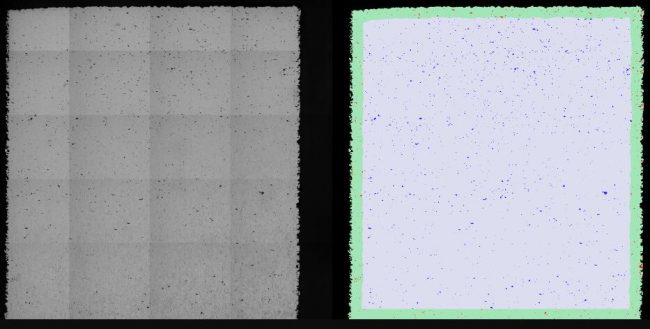 Polished section of a 10 mm copper cube – measured optical density of 99.3%
Designing triply periodic minimal surfaces in nTopology’s nTop Platform
nTopology software was used to generate triply periodic minimal surfaces (TPMS) that are ideal for heat exchangers as they generally require the amount of surface area within a given volume to be maximised. The design critieria for the TPMS gyrold structure was for a wall thickness of 0.35 mm and cell sizes of 2 and 5 mm. The nTopology software was used to slice the design into 30 micron layers and export the boundaries and hatches as CLI files. These were then imported into Renishaw’s QuantAM software to generate the build file for the AM process. Using CLI files removes the need for the traditional STL file format which has many disadvantages when used to describe complex intricate structures like these.
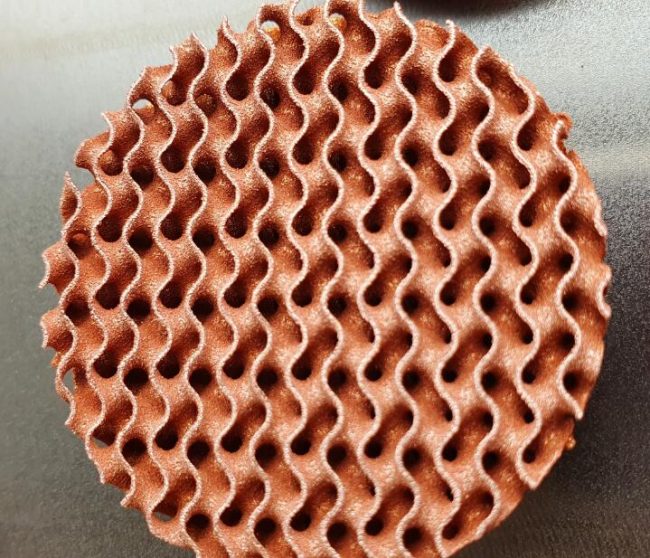 Gyroid with 0.35 mm Wall thickness and 5 mm cell size
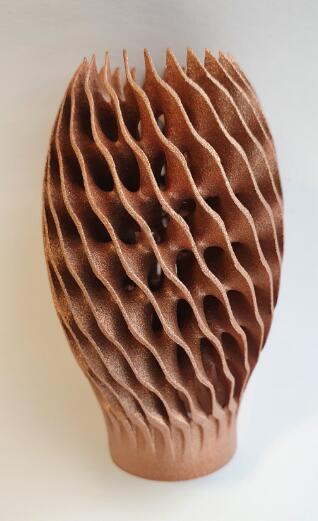 Copper Heatsink – Designed using nTopology. Made in a RenAM500S
The AM system has now been delivered and installed at Cooksongold, a supplier of fabricated precious metals based in Birmingham.
“We are very encouraged by the initial work and results provided by Renishaw and nTopology,” commented Ian Campbell, Industrial AM Program Manager at Cooksongold. “We look forward to using the machine to work on new customer applications for copper.”
Source: Renishaw
For press release, welcome to send to 3D Science Valley at 2509957133@qq.com

Recent Comments